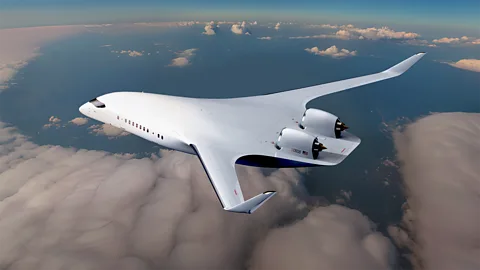
A revolutionary aircraft design, known as Blended Wing Body (BWB), is capturing the imagination of engineers and aviation enthusiasts worldwide. The concept, which merges the fuselage and wings into a single aerodynamic structure, promises unprecedented fuel efficiency, reduced emissions, and enhanced passenger comfort.
According to BBC Future (Nov. 9, 2025), the BWB design departs from conventional tube-and-wing aircraft by spreading the cabin across a wide, flattened fuselage. This allows more passengers per flight, greater internal volume flexibility, and smoother airflow, which significantly reduces drag.
Popular Mechanics reports that several aerospace companies, including NASA, Boeing, and Airbus, are actively exploring prototypes for commercial and military applications. Engineers highlight that the shape allows for lighter airframes, quieter flight, and even the potential for electric or hybrid propulsion systems in the next generation of aircraft.
The Verge notes that while the concept looks like something out of a sci-fi movie, testing has already demonstrated that the BWB can achieve 10–20% higher fuel efficiency than conventional designs. Safety remains a focus, with structural reinforcement and innovative evacuation strategies being incorporated into prototype designs.
Experts say passengers may notice differences inside as well: cabin layouts could be radically different, offering more spacious seating arrangements, panoramic windows, and flexible zones for lounges or workspaces.
While it may take a decade or more before blended-wing aircraft appear at commercial airports, the technology is being heralded as a game-changer for sustainable air travel and a glimpse into the future of aviation.
Sources
BBC Future — “Blended Wing Body: The Aircraft of the Future,” Nov. 9, 2025
Popular Mechanics — “NASA and Aerospace Giants Explore Futuristic Aircraft Design,” Nov. 9, 2025
The Verge — “Blended Wing Planes Could Revolutionize Air Travel,” Nov. 9, 2025
Aviation Week — “BWB Aircraft: Challenges and Opportunities for Commercial Flight,” Nov. 9, 2025