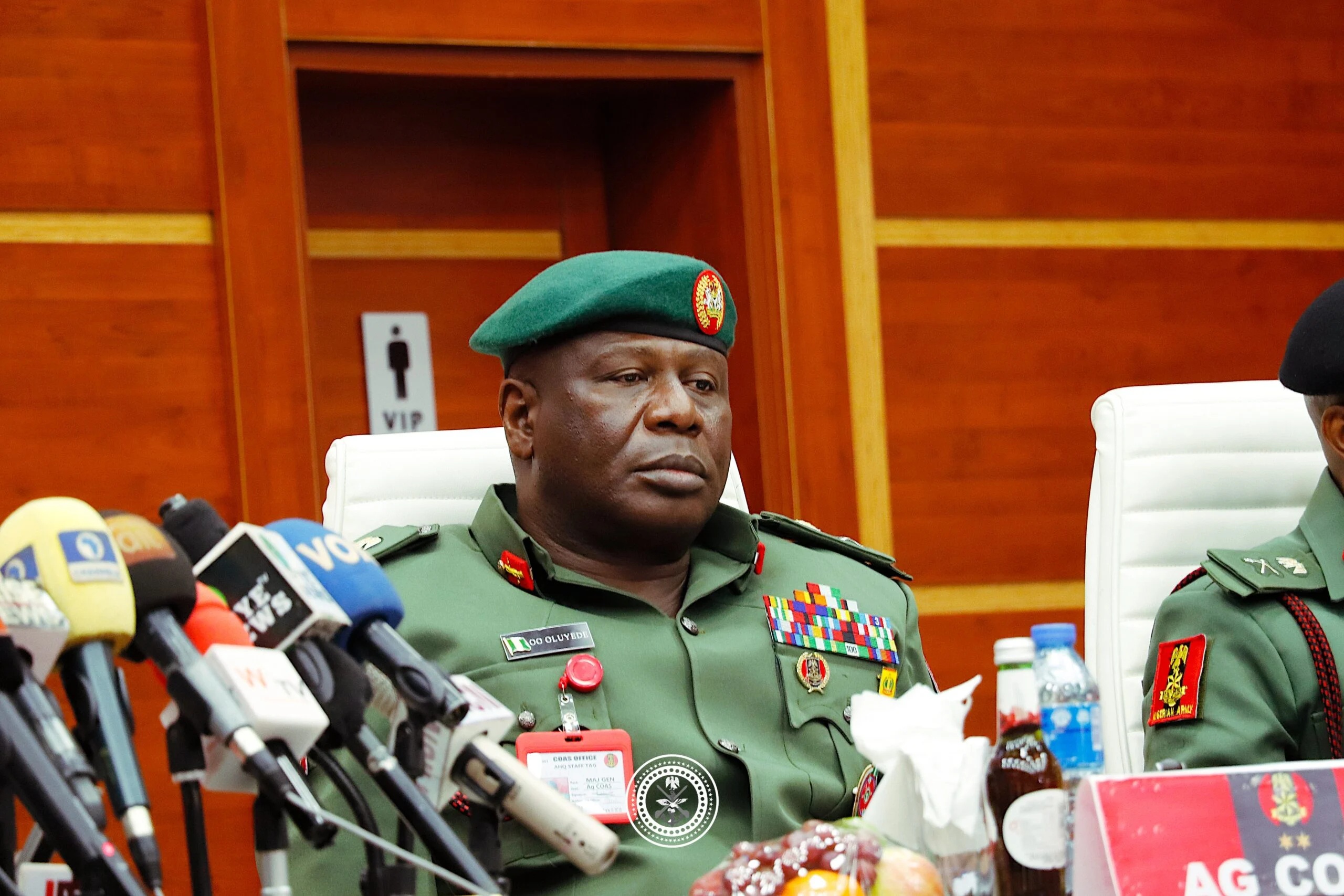
President Bola Ahmed Tinubu’s sweeping dismissal of Nigeria’s service chiefs has sent shockwaves through the country’s defence and political circles, sparking questions about loyalty, internal security, and the real motives behind the timing of the move. At the centre of this seismic reshuffle is Lieutenant-General Olufemi O. Oluyede, the newly appointed Chief of Defence Staff (CDS) — a name now synonymous with the administration’s bid to reassert control over the military amid whispers of a brewing coup.
A soldier forged in the battlefield
Oluyede, 56, is no stranger to Nigeria’s most intense theatres of conflict. Commissioned in 1992 from the Nigerian Defence Academy’s 39th Regular Course, he has served across multiple command and staff positions — from counterinsurgency operations in the North-East under Operation Hadin Kai, to peacekeeping assignments abroad. According to The Nation and Channels TV profiles, Oluyede is regarded within military ranks as a “quiet strategist” and a “soldier’s soldier” — a reputation built on operational discipline and field command experience. His rise through the ranks was steady: promoted to Major-General in 2020, appointed Chief of Army Staff in 2024, and now elevated to Chief of Defence Staff less than a year later. During his time as Army Chief, Oluyede reportedly emphasized improving troop welfare and operational coordination — a theme that aligns with President Tinubu’s repeated promises to “professionalize and depoliticize” the armed forces.
“He’s respected by the men, and he’s not seen as a political general,” a senior defence analyst told Reuters on Friday. “That alone makes him a stabilizing choice at a tense moment.”
A pattern of reshuffles — and political calculation
Presidential reshuffles of service chiefs are not unusual in Nigeria — but the context often tells the real story. From Obasanjo to Buhari, and now Tinubu, such decisions tend to follow moments of crisis or political unease. AP News reports that Tinubu’s latest changes come just weeks after internal military sources raised concerns about “growing restiveness” within the ranks over pay and command structure — allegations the Defence Headquarters quickly dismissed. Still, analysts suggest the timing of the sackings points to more than routine restructuring.
“When a president reshuffles all service chiefs simultaneously, it usually signals either loss of confidence or fear of insubordination,” said Dr. Nnamdi Eze, a security policy expert quoted by Premium Times. “Given Nigeria’s regional context — coups in Niger, Burkina Faso, and Mali — Tinubu is sending a message of zero tolerance for dissent.”
Historically, major service chief replacements have often coincided with political anxiety. In 1993, the Babangida regime reshuffled the top brass shortly before the annulled elections. In 2010, Goodluck Jonathan did the same after Yar’Adua’s illness triggered power struggles within the Defence HQ. Tinubu’s move — following reports of “undue interference” from certain quarters and intelligence warnings of “loyalty gaps” — fits the same pattern.
Security or survival? Analysts split on motive
Officially, the presidency says the reshuffle is “to reinvigorate Nigeria’s defence apparatus and strengthen inter-service coordination.” But security observers say it’s as much about political survival as security reform. Reuters cited two unnamed government sources claiming the changes were part of an ongoing plan to “align security leadership with the administration’s national security vision” — while quietly ensuring that no senior commander feels indispensable. Tinubu’s government, already under pressure from worsening insecurity in the North-West and South-East, faces the delicate balance of rebuilding trust in the armed forces without appearing to panic.
“It’s about control,” said Tomiwa Ogunleye, a Lagos-based geopolitical analyst. “Tinubu knows that in West Africa today, the military is the final arbiter of political power. He wants to make sure it stays firmly on the side of democracy — and his government.”
Regional ripples: The shadow of recent coups
The specter of military coups in neighbouring Niger, Burkina Faso, and Mali looms large over Nigeria’s political landscape. These nations share deep cultural and security ties with Nigeria, and their recent ruptures have emboldened anti-government rhetoric across the Sahel. While Nigerian defence officials dismiss talk of an imminent coup, the recent arrest of several mid-level officers over “conduct prejudicial to military discipline” (as reported by Premium Times) raised eyebrows. Tinubu’s decisive action, analysts say, may be designed to “reset” loyalty and deter any perception of weakness.
Who is Oluyede to Tinubu?
Though not considered part of Tinubu’s political inner circle, Oluyede’s promotion reflects a pattern of appointing professionally respected but politically neutral officers — a strategic balance that reduces factional rivalry within the armed forces. According to Reuters, Oluyede’s appointment “underscores Tinubu’s confidence in professional competence over political affiliation.” Still, some insiders argue that even in such merit-based choices, loyalty remains paramount.
“Professionalism is one thing, but trust is everything,” said a senior retired colonel interviewed by The Guardian Nigeria. “Tinubu wants a defence chief who won’t hesitate to neutralize threats — internal or external.”
The challenge ahead: rebuilding trust in uniform
As Nigeria battles terrorism, separatist unrest, and banditry, Oluyede faces a daunting task — uniting a military struggling with morale, logistics, and civilian distrust. A Grand View Research forecast suggests that Nigeria’s defence and security infrastructure market — including surveillance, cybersecurity, and AI-based analytics — is expected to grow steadily through 2030, but analysts warn that progress will depend heavily on leadership stability. Oluyede’s leadership will be tested in months, not years. He inherits a military stretched thin, a political class suspicious of its own protectors, and a president determined to avert the fate of his West African neighbours.
“In the oil era, power flowed from money,” said Eze, the security expert. “In today’s Nigeria, power flows from control of the guns. Tinubu understands that better than anyone.”